POWERCHINA's project team ensures the project pass manifold group hydrostatic test on the first attempt.
The joint hydrostatic test for the steel penstock manifold group in the powerhouse section of the Tarbela 5th Hydropower Extension Project in Pakistan was completed on March 30. Constructed by POWERCHINA, this achievement lays a solid foundation for meeting annual production targets and ensuring the first unit generates power on schedule.
Located approximately 113 kilometers northwest of Islamabad, Tarbela is currently Pakistan's largest hydropower station and the world's largest earth-and-rock fill dam project. The expansion project adds three 470 MW Francis turbine units, increasing the total installed capacity to 6,298 MW.
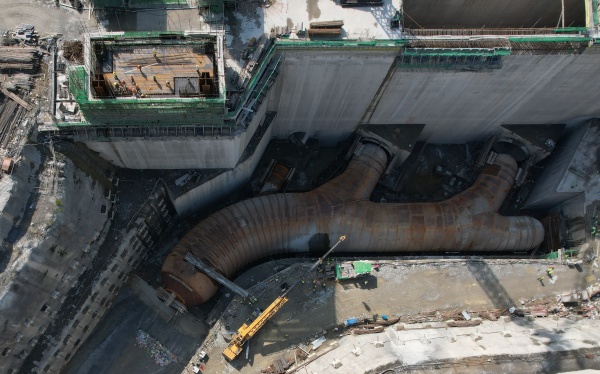
The project features a massive steel manifold system with a maximum diameter of 14.3 meters, a total fabrication weight of about 7,800 metric tons, and a maximum plate thickness of 130 millimeters, making it the largest steel manifold group currently under construction in the world.
The completed test involved a manifold group consisting of one relief pipe and three branch pipes. With a maximum common tangent sphere diameter of 14.6 meters and a total weight exceeding 12,000 metric tons after filling with water, the scale and construction difficulty represents a global pinnacle in engineering.
Due to the immense size and complex structure, the project demanded extremely rigorous standards for installation precision and welding quality. Since the start of installation, the project team has held several technical seminars to develop specialized construction plans, inviting leaders and experts to conduct in-depth evaluations of technical requirements and safety measures.
Throughout the construction process, strict quality control was maintained; prior to the test, multiple rounds of specialized briefings and training sessions were conducted, accompanied by comprehensive inspections and approvals. These efforts provided a solid foundation for passing the test on the first attempt.
The entire testing process lasted 64 hours. All parameters remained within normal ranges, and the installation quality received high praise from both the owner and the supervising engineers. This success fully validates the structural strength, welding quality, and design integrity of the manifold, establishing a vital safety line for the long-term stable operation of the power units.