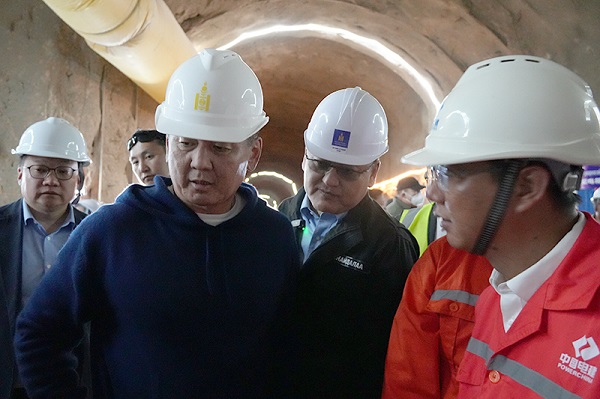
Mongolian President Ukhnaagiin Khürelsükh leads a delegation to visit the Erdeneburen Hydropower Project.
Mongolian President Ukhnaagiin Khürelsükh and his delegation visited the Erdeneburen Hydropower Project, currently being built by POWERCHINA, on Sept 13. At the construction site, Khürelsükh listened to a briefing on construction progress, unveiled the project's commemorative monument, and explored multiple construction zones, including the dam diversion tunnel, branch water diversion tunnel, and powerhouse, to inspect the engineering work firsthand.
During a discussion meeting, Khürelsükh spoke highly of POWERCHINA's project execution and construction management, and thanked the Chinese government for its support. He noted that the Erdeneburen Hydropower Project is a key national livelihood initiative for Mongolia, a major milestone in China-Mongolia bilateral cooperation, and a crucial step in advancing Mongolia's New Recovery Policy and the 2026-30 Five-Year Development Guideline.
While urging POWERCHINA to maintain safety and quality standards and speed up construction, he assured that Mongolia will help resolve construction hurdles to further deepen practical cooperation between the two countries in energy and infrastructure.
Located in western Mongolia about 120 kilometers from Khovd City, the Erdeneburen Hydropower Project is the country's largest national-level livelihood hydropower undertaking.
Utilizing a mixed development approach, the dam controls a drainage area of 45,055 square kilometers and features a total reservoir capacity of 1.14 billion cubic meters, providing multi-year regulation capabilities.
With a total installed capacity of 90 MW, the project will generate an average of 361 million kWh annually. Once completed, it will secure a stable power supply for five western provinces, enhance regional energy self-sufficiency, improve agricultural irrigation, boost tourism and fisheries, and support regional ecological conservation.