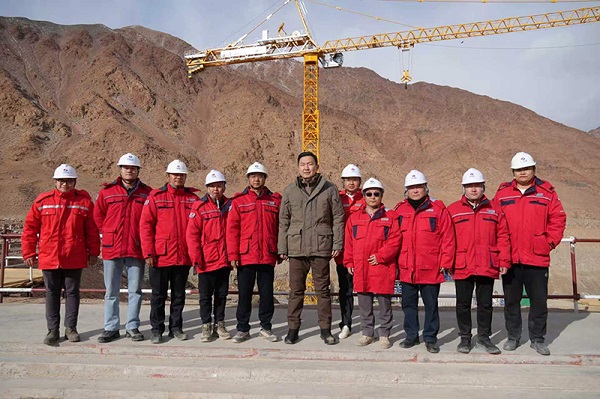
Mongolian Prime Minister Nyam-Osoryn Uchral (middle) learns about the construction progress at the Erdeneburen Hydropower Plant project, built by POWERCHINA.
Mongolian Prime Minister Nyam-Osoryn Uchral and Minister of Finance Mendsaikhan Zagdjav visited the Erdeneburen Hydropower Plant constructed by POWERCHINA on Oct 18.
Nyam-Osoryn Uchral spoke highly of the company's project execution and construction management capabilities, and extended his regards to the frontline construction personnel.
The delegation visited several construction sites, including the dam diversion tunnel, water intake branch tunnel, project monument, and powerhouse. Nyam-Osoryn Uchral noted that the plant is already 40 percent complete.
The energy sector is a fundamental pillar of Mongolia's economic independence and national security, and the Erdeneburen Hydropower Plant is a project of strategic and historical significance. It plays a vital role in ensuring the reliability of energy supply in the western region, reducing reliance on imported electricity, and increasing renewable energy generation.
He expressed hope that POWERCHINA will complete the project quickly and to a high standard, pledging that Mongolia will provide all necessary assistance for its construction.
Located in western Mongolia about 120 kilometers from Khovd City, the Erdeneburen Hydropower Plant is Mongolia's largest hydropower project and a key national livelihood initiative.
The dam site controls a watershed area of 45,055 square kilometers, with a total reservoir capacity of 1.14 billion cubic meters, offering multi-year regulation capabilities. The plant has a total installed capacity of 90 MW and an average annual power generation of 361 million kWh.
Once completed, the project will guarantee stable power supply for five provinces in western Mongolia, boost regional energy self-sufficiency, improve agricultural irrigation conditions, spur the development of tourism and fisheries, and support regional ecological conservation.